Gradient descent step size and momentum: roll a ball down a narrow valley
Afterwards you can explain why gradient descent diverges above a step size of 2/L, why it crawls in narrow valleys, even a line fit's, and how momentum helps.
- Topic
- Optimization
- Field
- Cross-disciplinary
- Prerequisites
- none beyond Python basics
- Libraries
matplotlib 3.11.2numpy 2.4.3
py-gradient-descent-valley.ipynb, executed with the versions above. The download needs a free account
Run it yourself. In a terminal, this installs exactly the versions above:
pip install numpy==2.4.3 matplotlib==3.11.2 jupyterlabPlay: roll a ball down a narrow valley
A narrow valley runs diagonally across the map below, its walls 100 times more steeply curved than its floor, and a ball rolls down it by gradient descent. Each hop goes straight downhill, and its length is the local slope times a fixed number η, the step size: a steep spot gives a long hop, a flat one a short hop. The loss on screen is the height f of the ball's spot, 0 at the bottom. Tap the map to place the ball or keep it where it is, set the step size η and the momentum β with the sliders or their − and + buttons, and press Go. Step makes a single hop, Reset puts the ball back at its start, and Line fit swaps in a second landscape. Watch the trail and the step counter. At η = 0.019 the ball reaches the minimum after 385 steps. At η = 0.021, a step size only about 10 % larger, it flies off the map after 23.
Show code
// game.js: roll a ball down a narrow valley by gradient descent with a step size η and a
// momentum β. The notebook writes both landscapes (Hessian, minimum, contour levels, the line
// fit's data) and a cividis color table into the #data element.
"use strict";

const DATA = JSON.parse(document.getElementById("data").textContent);
const TOL = 1e-3;                  // "at the minimum": closer than this
const MAX_STEPS = 20000;
const DOTS = 60;                   // the first steps get a dot each
const DECADES = 5;                 // the relief's colors span five decades of height
const RELIEF = 0.1;                // height of the shaded surface √(f − f*), for the hillshade
const LIGHT = [-1, 1, 1].map((c) => c / Math.sqrt(3));   // light from the upper left
const MAP_INK = "#1f2a44";        // ink and accent on the relief, which is the same in both themes
const MAP_ACCENT = "#c8553d";
const CIVIDIS = DATA.cividis.map((h) => [1, 3, 5].map((i) => parseInt(h.slice(i, i + 2), 16)));

// ---- the state: everything that changes, in one object
const state = {land: 0, eta: DATA.lands[0].eta.default, beta: 0, p: [0, 0], v: [0, 0],
  k: 0, status: "ready", start: [0, 0], trail: [], due: 0, hint: true};

function place(p) {                                     // the ball to p, at rest, trail cleared
  Object.assign(state, {p: [...p], v: [0, 0], k: 0, status: "ready", start: [...p], trail: [[...p]], due: 0});
}

function switchLand(i) {
  Object.assign(state, {land: i, eta: DATA.lands[i].eta.default});
  place(DATA.lands[i].start);
}

// ---- one gradient step with momentum; the notebook's descend() does the same arithmetic
function step(s) {
  const {H, pmin, half} = DATA.lands[s.land];
  const dx = s.p[0] - pmin[0], dy = s.p[1] - pmin[1];
  const g = [H[0][0] * dx + H[0][1] * dy, H[1][0] * dx + H[1][1] * dy];   // ∇f = H (p − p*)
  s.v = [s.beta * s.v[0] - s.eta * g[0], s.beta * s.v[1] - s.eta * g[1]];  // v ← βv − η∇f
  s.p = [s.p[0] + s.v[0], s.p[1] + s.v[1]];                                // p ← p + v
  s.k += 1;
  s.trail.push(s.p);
  const ex = s.p[0] - pmin[0], ey = s.p[1] - pmin[1];
  if (ex * ex + ey * ey < TOL * TOL) s.status = "arrived";
  else if (Math.max(Math.abs(ex), Math.abs(ey)) > half) s.status = "left";
  else if (s.k >= MAX_STEPS) s.status = "stopped";
}

const height = (lnd, dx, dy) => 0.5 * (lnd.H[0][0] * dx * dx + 2 * lnd.H[0][1] * dx * dy + lnd.H[1][1] * dy * dy);

// ---- the loop: slow at first, so that the zigzag can be followed, then faster
const rate = (k) => (k < 20 ? 8 : k < 400 ? 60 : 600);   // steps per second
function tick(dt) {
  if (state.status !== "running") return;
  state.due += Math.min(dt, 0.05) * rate(state.k);      // steps owed; the cap stops jumps
  while (state.due >= 1 && state.status === "running") {
    step(state);
    state.due -= 1;
  }
}

// Three significant digits: 4.9·10⁻⁷ when small, 0.00406 or 12.3 otherwise.
const SUP = {"-": "⁻", 0: "⁰", 1: "¹", 2: "²", 3: "³", 4: "⁴", 5: "⁵", 6: "⁶", 7: "⁷", 8: "⁸", 9: "⁹"};
function sig3(x) {
  if (x !== 0 && (Math.abs(x) >= 1e6 || Math.abs(x) < 1e-3)) {
    const [m, e] = x.toExponential(2).split("e");
    return `${Number(m)}·10${[...String(Number(e))].map((c) => SUP[c]).join("")}`;
  }
  return Number(x.toPrecision(3)).toLocaleString("en-US", {maximumFractionDigits: 6});
}

// ---- drawing
const canvas = document.getElementById("map");
const ctx = canvas.getContext("2d");
const $ = (id) => document.getElementById(id);
let view = {side: 100, dpr: 1};                        // the map's size in CSS px, set by layout()
let cache = {key: null, image: null};

function layout() {
  const W = document.documentElement.clientWidth, H = document.documentElement.clientHeight;
  const narrow = W < 600, dpr = window.devicePixelRatio || 1;
  let side = narrow ? W : Math.min(H, Math.round(0.6 * W));
  canvas.style.width = canvas.style.height = `${side}px`;
  if (narrow) {                                         // a short frame: a smaller map, so the panel fits
    const over = $("panel").scrollHeight - $("panel").clientHeight;
    if (over > 0) side = Math.max(160, side - over);
    canvas.style.width = canvas.style.height = `${side}px`;
  }
  canvas.width = canvas.height = Math.round(side * dpr);
  view = {side, dpr, narrow};
  render();
}

// Map units to CSS px: the square of half-width `half` around the minimum fills the canvas.
function toPixel(lnd, x, y) {
  const s = view.side / (2 * lnd.half);
  return [(x - lnd.pmin[0] + lnd.half) * s, (lnd.pmin[1] + lnd.half - y) * s];
}

// The relief, once per landscape and size: cividis of log height, lightened toward white,
// times a hillshade as if the surface √(f − f*) were lit from the upper left.
function relief(lnd, n) {
  const img = ctx.createImageData(n, n);
  const top = Math.max(height(lnd, lnd.half, lnd.half), height(lnd, lnd.half, -lnd.half));   // the highest corner
  const a = lnd.H[0][0], b = lnd.H[0][1], c = lnd.H[1][1];
  for (let j = 0; j < n; j++) for (let i = 0; i < n; i++) {
    const dx = ((2 * (i + 0.5)) / n - 1) * lnd.half, dy = (1 - (2 * (j + 0.5)) / n) * lnd.half;
    const h = height(lnd, dx, dy);
    const t = Math.min(1, Math.max(0, 1 + Math.log10(h / top) / DECADES));
    const r = RELIEF / (2 * Math.sqrt(h) || 1);          // slope of √h is ∇f / (2√h)
    const nx = -r * (a * dx + b * dy), ny = -r * (b * dx + c * dy);
    const shade = 1 + 0.3 * ((nx * LIGHT[0] + ny * LIGHT[1] + LIGHT[2]) / Math.hypot(nx, ny, 1) - LIGHT[2]);   // flat ground: 1
    const rgb = CIVIDIS[Math.round(63 * t)], o = 4 * (j * n + i);
    for (let q = 0; q < 3; q++) img.data[o + q] = (rgb[q] + 0.4 * (255 - rgb[q])) * shade;
    img.data[o + 3] = 255;
  }
  return img;
}

// The level sets of a quadratic are ellipses: ½ dᵀHd = c has semi-axes √(2c/λ) along H's main directions.
function drawContours(lnd, color) {
  const [a, b, c] = [lnd.H[0][0], lnd.H[0][1], lnd.H[1][1]];
  const angle = 0.5 * Math.atan2(2 * b, a - c), r = Math.hypot((a - c) / 2, b);
  const big = (a + c) / 2 + r, small = (a + c) / 2 - r;   // the two curvatures, big along angle
  const s = view.dpr * view.side / (2 * lnd.half);       // device pixels per map unit
  const [ox, oy] = toPixel(lnd, 0, 0);                    // the map's origin, in CSS px
  ctx.strokeStyle = color;
  ctx.lineWidth = 1;
  for (const level of lnd.levels) {
    ctx.setTransform(s, 0, 0, -s, ox * view.dpr, oy * view.dpr);   // draw in map units, y up
    ctx.beginPath();
    ctx.ellipse(lnd.pmin[0], lnd.pmin[1], Math.sqrt(2 * level / big), Math.sqrt(2 * level / small), angle, 0, 2 * Math.PI);
    ctx.setTransform(view.dpr, 0, 0, view.dpr, 0, 0);   // back to CSS px, so the line width stays even
    ctx.stroke();
  }
}

function drawInset(lnd, css) {                           // the data and the ball's line y = a + b x
  const w = 0.38 * view.side, h = 0.75 * w, x0 = view.side - w - 8, y0 = 8;
  const xs = [0.9, 2.1], ys = [Math.min(...lnd.y) - 1, Math.max(...lnd.y) + 1];
  const px = (x) => x0 + ((x - xs[0]) / (xs[1] - xs[0])) * w;
  const py = (y) => y0 + h - ((y - ys[0]) / (ys[1] - ys[0])) * h;
  ctx.save();
  ctx.fillStyle = css("--bg");
  ctx.globalAlpha = 0.92;
  ctx.fillRect(x0, y0, w, h);
  ctx.globalAlpha = 1;
  ctx.beginPath();
  ctx.rect(x0, y0, w, h);
  ctx.clip();
  const xbar = lnd.x.reduce((t, v) => t + v, 0) / lnd.x.length;
  ctx.strokeStyle = css("--muted");
  ctx.setLineDash([4, 3]);
  ctx.beginPath(); ctx.moveTo(px(xbar), y0); ctx.lineTo(px(xbar), y0 + h); ctx.stroke();
  ctx.setLineDash([]);
  ctx.fillStyle = css("--ink");
  lnd.x.forEach((x, i) => { ctx.beginPath(); ctx.arc(px(x), py(lnd.y[i]), 2.5, 0, 2 * Math.PI); ctx.fill(); });
  const [a, b] = state.p;
  ctx.strokeStyle = css("--accent");
  ctx.lineWidth = 2;
  ctx.beginPath(); ctx.moveTo(px(xs[0]), py(a + b * xs[0])); ctx.lineTo(px(xs[1]), py(a + b * xs[1])); ctx.stroke();
  const label = "y = a + b x";                          // in the lower right corner, below the data
  ctx.font = "14px system-ui, sans-serif";
  const tw = ctx.measureText(label).width;
  ctx.fillStyle = css("--bg");                          // a patch, so that the x̄ line does not cross it
  ctx.fillRect(x0 + w - tw - 9, y0 + h - 22, tw + 6, 19);
  ctx.fillStyle = css("--accent");
  ctx.textAlign = "right";
  ctx.fillText(label, x0 + w - 6, y0 + h - 7);
  ctx.restore();
}

function statusText(s) {
  const k = s.k.toLocaleString("en-US");
  if (s.status === "arrived") return `at the minimum after ${k} steps`;
  if (s.status === "left") return `left the map after ${k} steps`;
  if (s.status === "stopped") {
    const m = DATA.lands[s.land].pmin;
    return `stopped after ${k} steps, ${sig3(Math.hypot(s.p[0] - m[0], s.p[1] - m[1]))} from the minimum`;
  }
  return s.status === "running" ? "rolling" : s.status === "paused" ? "paused" : "ready";
}

function render() {
  const lnd = DATA.lands[state.land], root = getComputedStyle(document.documentElement);
  const css = (name) => root.getPropertyValue(name).trim();
  const n = canvas.width, key = `${state.land} ${n}`;
  if (cache.key !== key) cache = {key, image: relief(lnd, n)};
  ctx.setTransform(1, 0, 0, 1, 0, 0);
  ctx.putImageData(cache.image, 0, 0);
  drawContours(lnd, css("--muted"));

  // the minimum, the trail, dots at the first steps, and the ball
  const [mx, my] = toPixel(lnd, ...lnd.pmin);
  ctx.strokeStyle = MAP_INK;
  ctx.lineWidth = 2;
  ctx.beginPath(); ctx.moveTo(mx - 6, my - 6); ctx.lineTo(mx + 6, my + 6); ctx.moveTo(mx - 6, my + 6); ctx.lineTo(mx + 6, my - 6); ctx.stroke();
  const pts = state.trail.map((p) => toPixel(lnd, ...p));
  ctx.strokeStyle = ctx.fillStyle = MAP_ACCENT;
  ctx.lineWidth = 1.5;
  ctx.beginPath();
  pts.forEach(([x, y], i) => (i ? ctx.lineTo(x, y) : ctx.moveTo(x, y)));
  ctx.stroke();
  for (const [x, y] of pts.slice(0, DOTS + 1)) { ctx.beginPath(); ctx.arc(x, y, 2.5, 0, 2 * Math.PI); ctx.fill(); }
  const [bx, by] = toPixel(lnd, ...state.p);
  ctx.beginPath(); ctx.arc(bx, by, 7, 0, 2 * Math.PI); ctx.fill();
  ctx.strokeStyle = "#ffffff";
  ctx.lineWidth = 2;
  ctx.stroke();
  if (lnd.x) drawInset(lnd, css);

  // axis names at the lower and left edges, and the hint until the first Go or tap
  ctx.font = "14px system-ui, sans-serif";
  ctx.fillStyle = css("--muted");
  ctx.textAlign = "center";
  ctx.fillText(lnd.axes[0], view.side / 2, view.side - 6);
  ctx.save(); ctx.translate(14, view.side / 2);
  if (lnd.axes[1].length > 1) ctx.rotate(-Math.PI / 2);   // a single letter stays upright
  ctx.fillText(lnd.axes[1], 0, 0); ctx.restore();
  if (state.hint) {
    ctx.fillStyle = MAP_INK;
    ctx.fillText("tap the map to place the ball", view.side / 2, view.side - 26);
  }
  ctx.textAlign = "left";

  // the panel
  const f = height(lnd, state.p[0] - lnd.pmin[0], state.p[1] - lnd.pmin[1]) + lnd.fmin;
  $("count").textContent = `step ${state.k.toLocaleString("en-US")}`;
  $("loss").textContent = `loss ${Number.isFinite(f) ? sig3(f) : "∞"}`;
  $("status").textContent = statusText(state);
  const parts = [`curvatures ${sig3(lnd.lmin)} and ${sig3(lnd.L)}`, `κ = ${Math.round(lnd.kappa)}`, `2/L = ${(2 / lnd.L).toFixed(3)}`];
  $("info").textContent = parts.map((t) => t.replaceAll(" ", "\u00a0")).join(" · ");   // breaks only between parts
  const e = lnd.eta, digits = Math.round(-Math.log10(e.step));
  Object.assign($("eta"), {min: e.min, max: e.max, step: e.step});
  $("eta").value = state.eta;
  $("eta-val").textContent = state.eta.toFixed(digits);
  // the thumb's center runs from thumb/2 to 100% − thumb/2; the 2 px tick is centered on 2/L
  $("tick").style.left = `calc(${(2 / lnd.L - e.min) / (e.max - e.min)} * (100% - var(--thumb)) + var(--thumb) / 2 - 1px)`;
  $("beta").value = state.beta;
  $("beta-val").textContent = state.beta.toFixed(2);
  $("go-label").textContent = state.status === "running" ? "Pause" : "Go";
  document.querySelectorAll("#lands button").forEach((b, i) => b.classList.toggle("on", i === state.land));
}

// ---- controls, keys, and the loop
function set(partial) {                                 // run: n replays n steps from the start at once
  const {land, run, ...rest} = partial;
  if (land !== undefined && land !== state.land) switchLand(land);
  Object.assign(state, rest);
  if (run) {
    place(state.start);
    state.status = "running";
    while (state.status === "running" && state.k < run) step(state);
    if (state.status === "running") state.status = "paused";
    state.hint = false;
  }
  render();
}

const clamp = (x, lo, hi) => Math.min(hi, Math.max(lo, x));
function setEta(eta) {
  const e = DATA.lands[state.land].eta;
  set({eta: Number(clamp(eta, e.min, e.max).toFixed(Math.round(-Math.log10(e.step))))});
}
const setBeta = (beta) => set({beta: Number(clamp(beta, 0, 0.95).toFixed(2))});
const nudgeEta = (sign) => setEta(state.eta + sign * DATA.lands[state.land].eta.step);

function go() {
  if (state.status === "running") return set({status: "paused"});
  if (["arrived", "left", "stopped"].includes(state.status)) place(state.start);   // Go again replays
  set({status: "running", hint: false});
}
function oneStep() {
  if (["arrived", "left", "stopped"].includes(state.status)) place(state.start);
  step(state);
  if (state.status === "ready" || state.status === "running") state.status = "paused";
  set({hint: false});
}
const reset = () => { place(state.start); render(); };
const toggleLand = (i = 1 - state.land) => { switchLand(i); render(); };

$("eta").addEventListener("input", (e) => setEta(Number(e.target.value)));
$("beta").addEventListener("input", (e) => setBeta(Number(e.target.value)));
$("eta-down").addEventListener("click", () => nudgeEta(-1));
$("eta-up").addEventListener("click", () => nudgeEta(1));
$("beta-down").addEventListener("click", () => setBeta(state.beta - 0.05));
$("beta-up").addEventListener("click", () => setBeta(state.beta + 0.05));
$("go").addEventListener("click", go);
$("step").addEventListener("click", oneStep);
$("reset").addEventListener("click", reset);
document.querySelectorAll("#lands button").forEach((b, i) => b.addEventListener("click", () => toggleLand(i)));

// A tap places the ball; a finger that moves 10 px or more is scrolling the page instead.
let down = null;
canvas.addEventListener("pointerdown", (e) => { down = [e.clientX, e.clientY]; });
canvas.addEventListener("pointercancel", () => { down = null; });
canvas.addEventListener("pointerup", (e) => {
  if (!down || Math.hypot(e.clientX - down[0], e.clientY - down[1]) >= 10) return;
  down = null;
  const lnd = DATA.lands[state.land], r = canvas.getBoundingClientRect(), s = (2 * lnd.half) / view.side;
  place([lnd.pmin[0] - lnd.half + (e.clientX - r.left) * s, lnd.pmin[1] + lnd.half - (e.clientY - r.top) * s]);
  set({hint: false});
});

document.addEventListener("keydown", (e) => {
  const actions = {" ": go, s: oneStep, r: reset, l: () => toggleLand(),
    ArrowUp: () => nudgeEta(1), ArrowDown: () => nudgeEta(-1),
    ArrowRight: () => setBeta(state.beta + 0.05), ArrowLeft: () => setBeta(state.beta - 0.05)};
  const act = actions[e.key.length === 1 ? e.key.toLowerCase() : e.key];
  const native = (e.target instanceof HTMLInputElement && e.key.startsWith("Arrow"))
    || (e.target instanceof HTMLButtonElement && e.key === " ");   // the focused control handles these
  if (act && !native) {
    e.preventDefault();
    act();
  }
});

let last = null;
function frame(now) {                                   // called by the browser once per screen refresh
  const dt = last === null ? 0 : (now - last) / 1000;
  last = now;
  if (state.status === "running") {
    tick(dt);
    render();
  }
  requestAnimationFrame(frame);
}

place(DATA.lands[0].start);
window.addEventListener("resize", layout);
layout();
layout();                                               // again, now that the panel holds its text
requestAnimationFrame(frame);
window.game = {state, set, render};
A step size above 2/L throws the ball out of the valley
At η = 0.019 each hop across the floor lands a little lower on the opposite wall, at 0.021 a little higher.
Show code
import json
from pathlib import Path

import numpy as np
import matplotlib.pyplot as plt
from matplotlib import colors

plt.rcParams.update({
    "figure.figsize": (7, 3.6), "figure.dpi": 110,
    "axes.spines.top": False, "axes.spines.right": False,
    "axes.grid": True, "grid.alpha": 0.25,
    "font.size": 11, "lines.linewidth": 1.8,
})
INK, ACCENT, SECOND, MUTED = "#1f2a44", "#c8553d", "#2a7f9e", "#8a8f98"

TOL, MAX_STEPS, HALF = 1e-3, 20_000, 2.5            # "at the minimum", the cap, the map's half-width
ANGLE = np.radians(30)                              # the valley floor's direction on the map

# ---- landscape 1: f = ½(u² + 100 w²), u along the floor and w across it, turned by 30°
R = np.array([[np.cos(ANGLE), -np.sin(ANGLE)],      # columns: along the floor, across it
              [np.sin(ANGLE), np.cos(ANGLE)]])
H_valley = R @ np.diag([1.0, 100.0]) @ R.T
start_valley = R @ np.array([-1.6, 0.3])            # (u, w) = (-1.6, 0.3)

# ---- landscape 2: a straight line y = a + b x through 20 calibration points
rng = np.random.default_rng(359)
x = np.linspace(1.0, 2.0, 20)
y = 0.5 + 2.0 * x + 0.1 * rng.standard_normal(x.size)
X = np.column_stack([np.ones_like(x), x])
H_fit = X.T @ X / x.size                            # Hessian of the cost (1/2n) Σ (a + b x - y)²
pmin_fit = np.linalg.lstsq(X, y, rcond=None)[0]
fmin_fit = 0.5 * np.mean((X @ pmin_fit - y) ** 2)

LANDS = [
    dict(name="Valley", H=H_valley, pmin=np.zeros(2), fmin=0.0, start=start_valley,
         axes=["x", "y"], eta=dict(min=0.001, max=0.025, step=0.001, default=0.019)),
    dict(name="Line fit", H=H_fit, pmin=pmin_fit, fmin=fmin_fit, start=pmin_fit + np.array([-2.0, 1.0]),
         axes=["intercept a", "slope b"], eta=dict(min=0.01, max=0.75, step=0.01, default=0.58)),
]
for land in LANDS:                                  # 14 contour levels c·k², the outermost touching the square
    top = HALF**2 / (2 * np.max(np.diag(np.linalg.inv(land["H"]))))
    land["levels"] = top * (np.arange(1, 15) / 14) ** 2
valley, fit = LANDS

def descend(land, eta, beta=0.0, p0=None):
    """The game's step() repeated, same arithmetic in the same order: the trail and how it ended."""
    (h00, h01), (h10, h11) = land["H"].tolist()
    m0, m1 = land["pmin"].tolist()
    px, py = land["start"].tolist() if p0 is None else p0
    vx = vy = 0.0
    trail, status = [(px, py)], "stopped"
    for k in range(MAX_STEPS):
        dx, dy = px - m0, py - m1
        gx, gy = h00 * dx + h01 * dy, h10 * dx + h11 * dy        # ∇f = H (p - p*)
        vx, vy = beta * vx - eta * gx, beta * vy - eta * gy      # v ← βv - η∇f
        px, py = px + vx, py + vy                                # p ← p + v
        trail.append((px, py))
        ex, ey = px - m0, py - m1
        if ex * ex + ey * ey < TOL * TOL:
            status = "arrived"
            break
        if max(abs(ex), abs(ey)) > HALF:
            status = "left"
            break
    return np.array(trail), status

def steps(land, eta, beta=0.0):
    trail, status = descend(land, eta, beta)
    return len(trail) - 1, status

print(f"valley: start (x, y) = ({start_valley[0]:.3f}, {start_valley[1]:.3f}), "
      f"{np.linalg.norm(start_valley):.3f} from the minimum; line fit: a = {pmin_fit[0]:.3f}, b = {pmin_fit[1]:.3f}")
valley: start (x, y) = (-1.536, -0.540), 1.628 from the minimum; line fit: a = 0.378, b = 2.105
Show code
# ---- the map, by the game's rule: cividis of log height, lightened, times a hillshade of √(f - f*)
CIVIDIS = [colors.to_hex(c) for c in plt.get_cmap("cividis")(np.linspace(0, 1, 64))]
CIVIDIS_RGB = np.array([[int(h[i:i + 2], 16) for i in (1, 3, 5)] for h in CIVIDIS], dtype=float)
DECADES, RELIEF, DOTS = 5, 0.1, 60
LIGHT = np.array([-1.0, 1.0, 1.0]) / np.sqrt(3)     # from the upper left

def height(land, px, py):
    (a, b), (_, c) = land["H"]
    dx, dy = px - land["pmin"][0], py - land["pmin"][1]
    return 0.5 * (a * dx * dx + 2 * b * dx * dy + c * dy * dy)

def relief(land, xs, ys):
    """RGB image, rows ys (top first) by columns xs, in map units."""
    (a, b), (_, c) = land["H"]
    dx, dy = xs[None, :] - land["pmin"][0], ys[:, None] - land["pmin"][1]
    h = height(land, xs[None, :], ys[:, None])
    top = max(height(land, *(land["pmin"] + HALF * np.array(corner))) for corner in [(1, 1), (1, -1)])
    with np.errstate(divide="ignore"):
        t = np.clip(1 + np.log10(h / top) / DECADES, 0, 1)
    r = RELIEF / np.where(h > 0, 2 * np.sqrt(h), 1)
    nx, ny = -r * (a * dx + b * dy), -r * (b * dx + c * dy)
    shade = 1 + 0.3 * ((nx * LIGHT[0] + ny * LIGHT[1] + LIGHT[2]) / np.sqrt(nx**2 + ny**2 + 1) - LIGHT[2])
    rgb = CIVIDIS_RGB[np.round(63 * t).astype(int)]
    return np.clip((rgb + 0.4 * (255 - rgb)) * shade[..., None], 0, 255).astype(np.uint8)

def draw_map(ax, land, trails, n=360, window=None):
    """The game's map on ax; trails is a list of (trail, color, line width, number of dots).
    window = (x0, x1, y0, y1) shows a part of the map, in map units; the default is the game's square."""
    m0, m1 = land["pmin"]
    ext = window or (m0 - HALF, m0 + HALF, m1 - HALF, m1 + HALF)
    scale = n / max(ext[1] - ext[0], ext[3] - ext[2])  # pixels per map unit
    xs = np.linspace(ext[0], ext[1], round(scale * (ext[1] - ext[0])))
    ys = np.linspace(ext[3], ext[2], round(scale * (ext[3] - ext[2])))
    ax.imshow(relief(land, xs, ys), extent=ext, interpolation="bilinear")
    gx, gy = np.meshgrid(xs, ys)
    ax.contour(gx, gy, height(land, gx, gy), levels=land["levels"], colors=MUTED, linewidths=0.7)
    ax.plot(m0, m1, "x", color=INK, ms=7, mew=2)
    for trail, color, lw, dots in trails:
        ax.plot(*trail.T, color=color, lw=lw)
        ax.plot(*trail[:dots + 1].T, "o", ms=2.5, color=color)
        ax.plot(*trail[-1], "o", ms=8, color=color, mec="white", mew=1.5)
    ax.set(xlim=ext[:2], ylim=ext[2:], aspect="equal", xticks=[], yticks=[])
    ax.set_xlabel(land["axes"][0], color=MUTED)
    ax.set_ylabel(land["axes"][1], color=MUTED)
    ax.spines[:].set_visible(False)
    ax.grid(False)
    return ax

def across(trail):                                   # w, the offset across the valley floor
    return trail @ R[:, 1]

def along(trail):                                    # u, the distance along it
    return trail @ R[:, 0]
Show code
fig, axes = plt.subplots(2, 2, figsize=(8, 7), gridspec_kw=dict(height_ratios=[1.35, 1], hspace=0.25))
for col, (eta, label) in enumerate([(0.019, "factor −0.9"), (0.021, "factor −1.1, left after 23 steps")]):
    trail, status = descend(valley, eta)
    first = trail[:26]
    draw_map(axes[0, col], valley, [(first, ACCENT, 1.2, 25)])
    axes[0, col].text(0.03, 0.97, f"η = {eta}: {label}", transform=axes[0, col].transAxes, va="top",
                      color=ACCENT, fontsize=10, bbox=dict(fc="white", ec="none", alpha=0.85, pad=2))
    ax = axes[1, col]
    k, w = np.arange(len(first)), across(first)
    ax.vlines(k, 0, w, color=INK, lw=1.2)
    ax.plot(k, w, "o", ms=4, color=INK)
    envelope = 0.3 * abs(1 - eta * 100) ** np.linspace(0, 25, 200)
    for sign in (1, -1):
        ax.plot(np.linspace(0, 25, 200), sign * envelope, ls="--", lw=1, color=MUTED)
    ax.set(xlabel="step k", xlim=(-0.5, 25.5), ylim=(-3, 3))
axes[1, 0].set_ylabel("offset across the floor w")
plt.show()
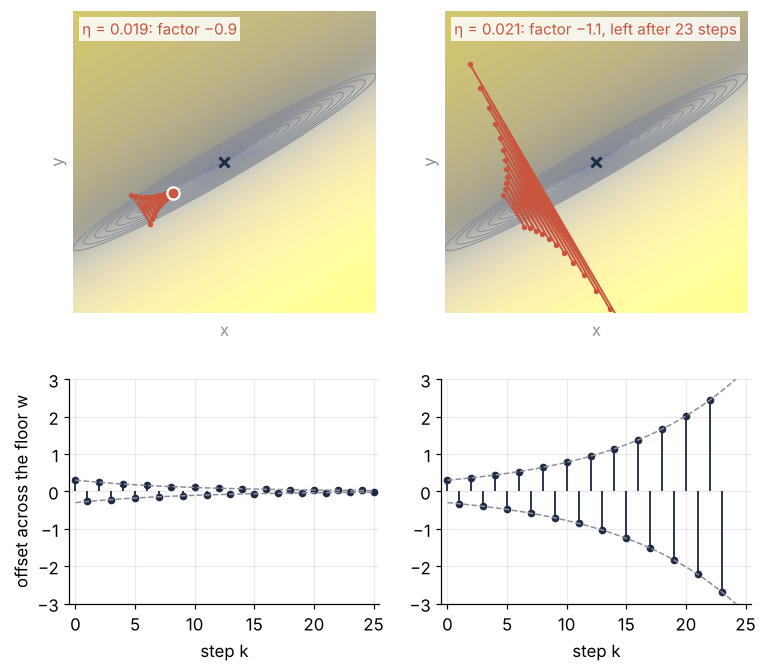
Cut the valley straight across and you get a parabola, ½ L w², with w the offset across the floor and L = 100 its curvature. A hop subtracts η times the slope L w, which multiplies the offset by a fixed factor:
At η = 0.019 the factor is −0.9: the ball overshoots the floor but lands 10 % closer each time. At 0.021 it is −1.1, and every overshoot outgrows the last. The factor stays between −1 and 1 only for η < 2/L = 0.020.
In two dimensions the gradient ∇f is the pair of slopes (∂f/∂x, ∂f/∂y), an arrow pointing straight uphill, as long as the slope is steep. Gradient descent steps against it:
In the valley's own coordinates, u along the floor and w across it, the height is
so the gradient is (u, 100 w), and the rule above applies to each direction alone, with its own curvature: \(\lambda_{\min}\) = 1 along the floor, L = 100 across.
Every tilted quadratic bowl has two such perpendicular directions, and the eigenvalues of its Hessian H, the 2 × 2 table of second derivatives of f, are the curvatures along them. The largest sets the limit, because a step that is stable along the floor can still be unstable across it.
The cell below gets both curvatures from H with eigvalsh, NumPy's eigenvalues of a symmetric matrix. Then steps replays the game's own hop, shown in How the game computes it, until the ball is within 10⁻³ of the minimum or off the map.
curvatures = np.linalg.eigvalsh(H_valley)           # ascending: along the floor, across it
lam_min, L = curvatures
print(f"curvatures {lam_min:.0f} and {L:.0f}, limit 2/L = {2 / L:.3f}")
for eta in [0.01, 0.019, 0.021]:
    print(f"η = {eta:5.3f}: factor across 1 - ηL = {1 - eta * L:+.1f}")
for eta in [0.019, 0.021]:
    k, status = steps(valley, eta)
    print(f"η = {eta}: {'at the minimum' if status == 'arrived' else 'left the map'} after {k} steps")
curvatures 1 and 100, limit 2/L = 0.020
η = 0.010: factor across 1 - ηL = +0.0
η = 0.019: factor across 1 - ηL = -0.9
η = 0.021: factor across 1 - ηL = -1.1
η = 0.019: at the minimum after 385 steps
η = 0.021: left the map after 23 steps
Free account
The second half of this tutorial needs a free account
Sign in, or create an account with your email address, and the page goes on right here. The account costs nothing and also brings the notebook download, collections, and done marks.
Still to come
- Zigzag, then crawl: the condition number counts the steps
- The same narrow valley in a straight-line fit
- Momentum shortens the crawl
- How the game computes it
- Variations
- Further reading